Shingles cost the least up front and fit most homes and budgets. Metal costs more but lasts decades longer and sheds snow, though big hail can dent it and it needs snow guards. Both can be built for Davis County's canyon winds. Standing seam is the premium metal roof; exposed-fastener panels like Tuff Rib get most of metal's benefits for less. The right pick comes down to how long you'll stay, your snow and wind exposure, and your budget.
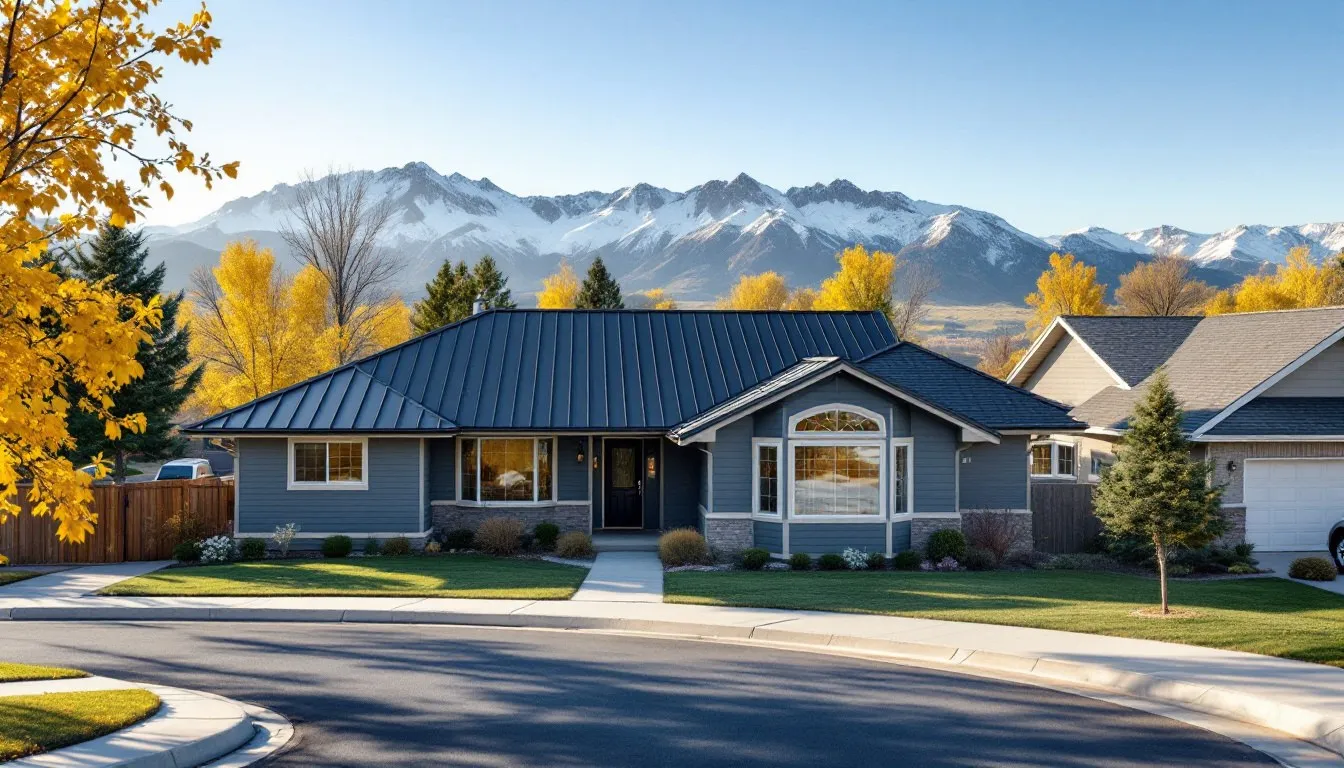
Metal roofs are showing up on more Wasatch Front homes every year, and it’s easy to see why. Davis County roofs deal with real snow, east winds that come down the canyons at hurricane force, and a sun at 4,300 feet that dries asphalt out faster than the brochure promises.
But metal isn’t automatically the better roof. It’s a different set of trade-offs, and the right answer depends on the house, the budget and how long you plan to live there. We install both, so here’s how they honestly compare on the things that matter here.
The two roofs we’re comparing
Architectural asphalt shingles are the thick, dimensional shingles on most homes built or reroofed in the last twenty years. Ours are GAF Timberline HDZ, installed with GAF’s matched starter strip, ridge caps, underlayment, leak barrier and ventilation, so every layer works as one system. (Every layer of a GAF roof is on our shingle page.)
Metal comes in two main styles for homes:
- Standing seam: smooth panels running from the eave to the ridge, joined by raised seams, with the fasteners hidden underneath on clips that let the panels move as they heat and cool. It’s the premium metal roof.
- Exposed-fastener ribbed panels like Tuff Rib: steel panels screwed through the face with sealing washers. Most of metal’s toughness at a price much closer to shingles.
How long each one lasts
InterNACHI, the national home inspectors’ association, estimates about 30 years for architectural asphalt shingles and 40 to 80 years for metal roofing. The Metal Roofing Alliance, the industry’s trade group, says 30 to 50 years or more. The spread is wide because “metal” covers everything from a barn roof to a premium standing seam system, and because installation and maintenance decide where a roof lands in the range.
Two things push a roof toward one end or the other here. The first is our altitude. At 4,300 feet the sun is harder on asphalt than the same shingle sees at sea level, so attic ventilation and an annual look matter more. The second, on metal, is the fasteners. A standing seam roof has nothing exposed to wear out. An exposed-fastener roof only reaches the long end of its range if its screws are looked after (more on that below).
What each costs up front
We don’t publish prices because every roof is different, but the order is consistent: architectural shingles cost the least, exposed-fastener metal like Tuff Rib comes next, and standing seam costs the most. Depending on whose numbers you use, standing seam runs roughly one and a half to three times the cost of an architectural shingle roof on the same house. Standing seam costs more for real reasons: narrower panels mean more pieces to handle, there’s more trim, and the panels are formed and seamed with more labor.
The better way to compare is cost per year of roof. If you’ll be in the house for twenty years or more, metal’s price is spread across a much longer life and can come out ahead. If you plan to sell in a few years, shingles almost always make more sense. Remodeling magazine’s annual Cost vs. Value report, which surveys real estate agents, has a new asphalt roof recouping a larger share of its cost at resale than a new metal one, year after year.
Snow and ice
This is where the two roofs behave most differently, and it matters here. Davis County averages around 60 inches of snow a season on the valley floor and up to about 90 on the benches, according to the county.
A metal roof sheds snow. Instead of carrying the load all winter, the snow slides off once the sun warms the panels. That’s easier on the rafters and means less snow sitting at the eaves. It also means snow can come off in a single sheet, all at once. The Metal Construction Association calls sliding snow a life-safety issue, because a roof can dump a lot of weight in a few seconds. That’s what snow guards are for: they hold the snow in place so it melts off gradually. The association’s guidance is to protect the whole eave line, not just the spot over a door, since snow doesn’t pick where it lets go. We plan snow retention with you at the estimate, with the most attention over entries, walkways, driveways, decks and any lower roof below.
A shingle roof holds its snow. On a well-built roof that’s fine, but it does mean the eaves need protection from ice dams. Ice dams form when heat leaking from the house melts snow on the upper roof and the water refreezes at the cold overhang. Metal reduces the problem by shedding snow, but snow still collects behind snow guards and in valleys, so either roof needs the same fundamentals: good attic ventilation and insulation, and leak barrier at the eaves and valleys so water backing up behind ice has nowhere to go.
Canyon wind
Davis County’s east winds are a genuine roofing problem. The December 1, 2011 windstorm brought gusts of 102 mph in Centerville and 92 in West Bountiful, and a September 2020 event clocked a 99 mph gust in Farmington. Kaysville and Farmington design homes for a 140 mph wind speed for exactly this reason.
Shingles fail in wind from the edges. Once a shingle’s seal breaks, the next gust gets under it more easily, which is why wind damage spreads. At a 140 mph design speed, building code requires shingles that carry the top wind classifications (ASTM D7158 Class H or ASTM D3161 Class F). Timberline HDZ carries both. Installed with GAF’s full accessory system, it also qualifies for GAF’s WindProven limited wind warranty, which has no maximum wind speed. (What to check after a windstorm has its own guide.)
Metal panels interlock and fasten along their length, so there are no tabs to lift. A metal roof’s wind rating, though, applies to the exact system that was tested: the panel, its gauge, the clips or screws and their spacing. The weak points are the edges and trim, which is where installation earns its keep, on either roof.
Hail
Hail is the one category where metal isn’t the clear winner, and it’s worth understanding before you choose. Utah’s state hazard plan puts hail risk highest in the Wasatch Front counties.
A steel roof rarely gets punctured by hail, but large hail can dent it. The Insurance Institute for Business & Home Safety (IBHS), which tests roofs for the insurance industry, says there’s currently no evidence that dents affect how a metal roof performs. Most dents are cosmetic.
The catch is in the insurance policy. Some policies carry a cosmetic damage exclusion, an optional endorsement insurers have offered for years, sometimes in exchange for a small premium credit. Under one, a dented metal roof that still keeps water out may not be covered. Read your policy, or ask your agent, before you choose metal partly on the assumption that a hail claim will work the way it does on shingles.
Shingles take hail differently. A strong hit can bruise the shingle, knock granules loose or crack the mat, and that damage shortens the roof’s life even when it’s hard to see from the ground. Impact-rated versions of both shingles and metal are tested to UL 2218, and some insurers discount premiums for Class 4 roofs. (After a hailstorm, here’s what to do first.)
Noise, heat and fire
Noise. A residential metal roof goes over solid decking and underlayment, and that’s what keeps it quiet. The drumming people remember comes from barns and sheds with nothing under the panels. You may hear a hard rain or hail a little more under metal, but it’s nothing like a pole barn.
Heat. Reflective “cool roof” finishes keep an attic cooler in summer, and the EPA estimates cool roofs can cut peak cooling demand by 11 to 27 percent in air-conditioned homes. Many metal finishes are rated for reflectance, and so are some lighter shingle colors, including a few in the Timberline HDZ line. With July highs near 90 degrees here, that’s worth asking about on either roof.
Fire. Timberline HDZ carries a Class A fire rating, the highest there is. Steel itself won’t burn, but on a wood-framed house a metal roof’s Class A rating depends on the tested assembly underneath it. Ask for the rating of the whole system, not just the panel.
Standing seam or Tuff Rib?
If you’ve decided on metal, this is the next choice.
Standing seam hides its fasteners under the seams on clips that let the panels move with the temperature. No screws or rubber washers sit in the sun, so it lasts longest and needs the least attention. That’s why it costs more. It’s also the cleanest look on a home, snow guards clamp onto the seams without putting a hole in the panel, and code allows it on much lower slopes than lapped panels.
Tuff Rib is screwed through the face of the panel. You get steel, snow shedding and wind resistance at a much lower price. The trade is maintenance. The screws’ rubber washers age in the sun, and steel panels expand and contract with every hot afternoon and cold night, which can work screw holes larger over time. So the fasteners need a checkup every few years, and some screws get replaced over the life of the roof. Lapped panels like these also need a steeper roof, at least 3 in 12 under building code without sealant at the laps.
We’ll put both on your estimate side by side, along with shingles, so you’re comparing real numbers for your house.
Looks, HOAs and colors
Metal reads very differently from the street, and in some Davis County neighborhoods that matters. Utah law doesn’t override an HOA’s architectural rules on roofing materials, so if you’re in one, check the CC&Rs and get approval before you order anything. Both shingles and metal come in a wide range of colors, and our color options page shows the shingle and metal colors side by side.
Which one fits your house?
Shingles probably make sense if:
- You plan to sell in the next several years.
- You want the lowest upfront cost.
- Your roof has lots of valleys, dormers and angles, where metal takes more labor.
- Your HOA prefers or requires them.
Metal is worth a serious look if:
- This is the house you plan to stay in for a long time.
- You’re on the benches, where snow loads and canyon winds run highest.
- Snow sliding off the roof won’t land on a door, walkway or driveway, or you’re ready to put snow guards where it would.
- You’d rather not think about your roof again for a very long time.
Common questions
Is a metal roof louder when it rains?
A little, sometimes. Over solid decking and underlayment, the way homes are built, most people find the difference small. The loud metal roofs people picture are on barns and sheds with no deck under the panels.
Will a metal roof lower my insurance?
It might, but don’t count on it. Some insurers discount premiums for impact-rated roofs, and some policies limit coverage for cosmetic hail dents on metal. The only reliable answer is your own policy, so ask your agent before you decide.
Can metal go over my existing shingles?
Sometimes, but we recommend tearing off. Utah follows the International Residential Code, which allows a new roof over an old one only in limited cases, and never over a roof that’s water-soaked, deteriorated or already has two layers. Even when it’s allowed, a tear-off is the only way to see the decking and fix soft spots, and a roof meant to last for decades should start on a sound deck.
Does a metal roof need maintenance?
Standing seam needs very little. Exposed-fastener metal needs its screws checked every few years. Either way, a look after a big windstorm or hailstorm is a good habit, and ours is free.
The bottom line
There’s no wrong answer between a good metal roof and a good shingle roof, only a better fit for your house and your plans. Shingles are the practical choice for most homes and budgets. Metal is the long-haul choice, built for snow, wind and decades of sun. At a free inspection we’ll look at your roof’s pitch, decking, snow exposure and what sits below the eaves, then price the options side by side so you can choose. You can read more on our metal roofing page and our roof replacement page.
The inspection is free, and we photograph everything we find.