
An ice dam needs snow on the roof, a roof deck warmed above freezing by heat escaping the house, and a cold eave where the meltwater freezes again. Heat tape keeps a drain path open but doesn't touch the cause. What stops ice dams is sealing the air leaks into the attic, then insulating, then venting the underside of the roof. Leak barrier at the eaves limits the damage when a dam forms anyway.
Every winter on the Wasatch Front, some roofs grow a thick ridge of ice along the eaves with a row of long icicles under it, while the house next door stays clean. Same snow, same street. The difference is almost always under the roof, in the attic.
Davis County gets real snow. The county puts a winter’s snowfall at roughly 60 inches on the valley floor and up to 90 inches on the high benches, with lake-effect storms off the Great Salt Lake adding to it. January nights average around 20 degrees, and the swing between day and night can run as wide as 55 degrees. That’s the setup ice dams need, and it comes around every year.
Here’s how an ice dam forms, what heat tape can and can’t do, and what actually stops them, in the order it matters.
How an ice dam forms
An ice dam takes three things at once: air below freezing outside, a roof deck above freezing, and snow on the roof.
Heat from the house warms the upper part of the roof deck. The snow sitting on it melts from underneath, and the water runs downhill under the snowpack. When it reaches the eave, it’s over the overhang, outside the walls of the house, where the roof is as cold as the air. There it freezes. Every day of melting adds to the ridge, and the next round of meltwater pools behind it.
Shingles are made to shed water running downhill. They aren’t made to hold back a pond. Water trapped behind the ice works up under the shingles and finds its way into the attic, the top of the walls or the ceiling below.
Snow makes it worse. Building scientist Joseph Lstiburek, drawing on the Army Corps of Engineers’ cold-regions research, puts snow at about R-1 per inch. A foot of snow on a roof is an insulating blanket of roughly R-10 to R-15 that holds the house’s heat against the deck. More snow means more ice damming, which is worth knowing on the benches, where the county’s snowfall figures run highest.
Where the heat comes from
University of Minnesota Extension puts it plainly: the uneven roof temperatures come mostly from heat flowing out of the house, and air leaking into the attic is often the biggest part of it. The usual leaks:
- Recessed “can” lights and other ceiling light fixtures
- The attic hatch or pull-down stairs
- Holes where plumbing, wiring and ducts pass through the ceiling
- Bathroom and kitchen exhaust fans and their ducts
- Chimneys, especially with a wood stove or fireplace in regular use
- Heating ducts that run through the attic
- The spaces behind knee walls in finished upper rooms
Signs you have an ice dam
- A thick ridge of ice along the eave, sometimes with slush or water sitting behind it.
- Big icicles along the full length of an eave. Not every icicle is a problem. Small ones on a sunny slope come from the sun, not the attic, and Lstiburek notes they don’t back water up. The heavy ones along the whole edge of a heated part of the house are the warning.
- Water stains or peeling paint on ceilings and on the top of exterior walls.
- Damp or matted insulation, or frost on the underside of the roof deck when you look in the attic. Both point to warm, moist air from the house getting into the attic.
- Bare stripes on your roof while the neighbors’ roofs are still white. A day or two after a snowstorm, compare. Snow that melts off over the warm part of the house shows you where heat is getting through.
If you have an ice dam right now
Stay off the roof. Minnesota Extension warns that anyone on a roof in winter, or working on one from below, risks injury, and it says to have professionals do the job. Lstiburek is blunter: people die every year falling off roofs trying to get rid of ice dams, or when big ones fall on them.
Keep people and cars out from under heavy ice. Ice falling from an eave can hurt someone.
If you clear snow yourself, do it from the ground. A roof rake on a long handle can clear the first few feet of snow above the eave without a ladder, and less snow means less melt feeding the dam. Rake gently and don’t scrape down to the shingles, since a rake can damage them. North Dakota State University Extension adds a warning worth repeating: watch for overhead power lines.
Don’t chip at the ice. Hacking, prying or hammering at an ice dam breaks shingles.
Inside, catch the water and take pictures. Put down buckets and towels, move what you can, and photograph the stains and the eaves with the date showing. If water got in, call your insurance agent. Whether it’s covered depends on your policy.
Let it dry before you patch. Minnesota Extension advises waiting until ceilings and walls are fully dry before repairing them, and fixing the heat loss at the same time so it doesn’t happen again.
If water is coming in now, start with our emergency roof repair page. We clear ice dams safely and repair what the water did, then look at what caused it.
Heat tape: what it does and what it doesn’t
Heat tape, also called heat cable, is an electric cable clipped along the lower edge of the roof in a zigzag. The usual install runs it into the gutter and down the downspout. The point is to keep a path open so meltwater can drain off the roof instead of pooling behind the ice.
What it doesn’t do is fix anything. The house is still losing heat into the attic. The snow is still melting where it shouldn’t. Heat tape spends electricity melting a channel through ice that the house’s own lost heat created. Tom Silva, This Old House’s general contractor, calls it a Band-Aid that “doesn’t fix the problem.” North Dakota State University Extension calls it treating the symptom and wasting energy. Lstiburek’s term is throwing energy at the problem.
Heat tape can still earn its place in two cases:
- Where there’s no attic to fix, like a vaulted ceiling with the roof deck right above it.
- As a stopgap for a winter, until the attic work is done.
If you use it, use it carefully:
- Ground-fault protection, every time. This Old House calls for a GFCI-protected circuit, and the National Electrical Code, which Utah adopts, requires ground-fault protection on fixed outdoor de-icing equipment. Have a licensed electrician do anything hard-wired.
- Clips, never nails. Every nail or screw through a shingle is a hole in the roof.
- Give the water a way out. The cable has to run through the gutter and down the downspout, and the gutter has to be clear. A gutter packed with leaves or ice gives the meltwater nowhere to go, so clean them out in the fall.
- Check it before every winter. Follow the maker’s instructions and look for worn or damaged cable before the first storm.
What actually stops ice dams
The goal is simple to say: keep the roof deck below freezing whenever it’s below freezing outside. Lstiburek lays out three steps, and the order matters.
1. Seal the air leaks into the attic
This comes first because it does the most. Lstiburek’s verdict is that airtightness matters more than how much insulation there is, though both count. Minnesota Extension’s first long-term step is the same: make the ceiling airtight so no warm, moist air flows from the house into the attic. That means sealing around the light fixtures, pipes, wires, ducts, flues and hatch on the list above. Heating ducts running through a cold attic are one of the worst offenders, because they leak air and lose heat at the same time.
One caution from Minnesota Extension: when a house gets tighter, furnaces, water heaters and fireplaces still need enough air to run safely, so have that checked as part of the work.
2. Insulate on top of the seal
Once the ceiling is sealed, insulation slows the heat that’s left. For an existing home in Davis County’s climate zone, ENERGY STAR’s retrofit guide recommends adding R60 to an uninsulated attic, or R49 where there’s already 3 to 4 inches.
Keep it off the vents. North Dakota State University Extension’s advice is to make sure insulation doesn’t block the airflow from the soffits, using baffles at the eaves to hold it back.
3. Vent the underside of the roof
Some heat will always get past the first two steps. Ventilation carries it away: outside air comes in at the soffits, washes along the underside of the roof deck and leaves at or near the ridge. Lstiburek’s standard is every rafter bay, not every third one.
Ventilation can’t make up for a leaky ceiling. It only removes small amounts of heat, so it works after the first two steps, not in place of them. Minnesota Extension also doesn’t recommend powered attic fans as a fix for ice dams.
This step is part of the roof, and it’s where we come in. Every shingle roof we build includes GAF ventilation matched to the attic, and if you’re getting estimates for a new roof, ventilation should have its own line. (Here’s what else should be on a roofing estimate.)
Leak barrier: the backup, not the cure
Utah builds homes to the International Residential Code. Where the local jurisdiction has designated a history of ice dams, the code requires an ice barrier at the eaves in place of regular underlayment. It runs from the edge of the roof to at least 24 inches inside the exterior wall line, and on steep roofs (8 in 12 or steeper) it also has to reach at least 36 inches up the slope from the eave edge. On a house with a deep overhang, that’s a wide strip.
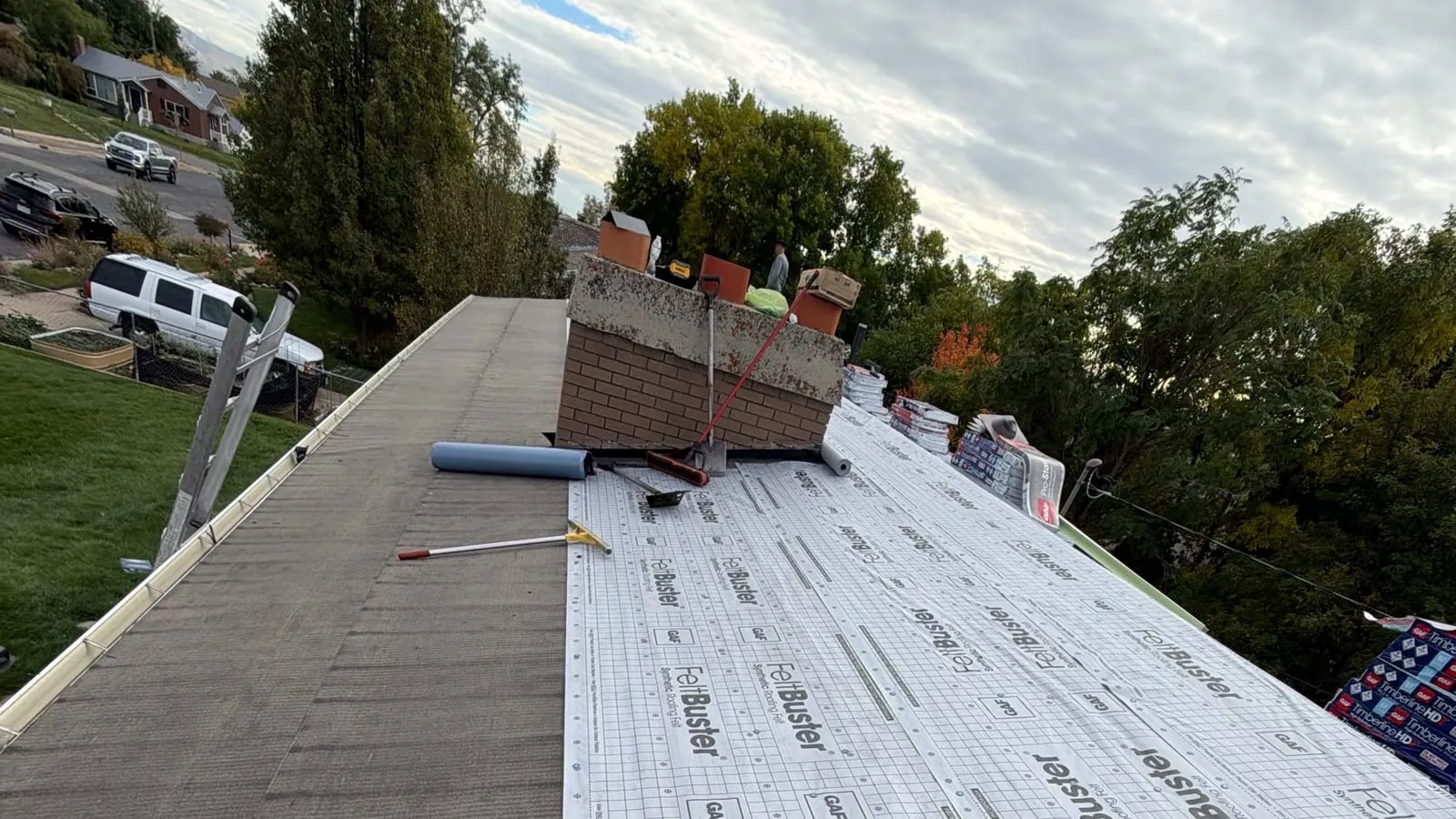
On every shingle roof we build, GAF leak barrier goes at the eaves and in the valleys, the places where ice dams back water up. It’s there for the day a dam forms anyway.
But be clear about what it is. Lstiburek points out that a water-protection membrane doesn’t prevent the ice dam. It only limits the damage. A new roof over the same leaky, under-insulated attic will grow the same ice dam next winter, just with a better backstop under it. If you’re replacing the roof anyway, that’s the best time to fix the ventilation too.
A metal roof changes the picture somewhat, because it sheds snow instead of holding it. It still needs snow guards so the snow doesn’t come off all at once, and snow still collects behind them. Our metal roof vs. shingles comparison covers that.
Common questions
Is heat tape worth it?
As a fix, no. As a stopgap, or on a roof section with no attic behind it, it can be. If your eaves ice up every winter, the money usually does more in the attic.
Will a new roof stop ice dams?
Not by itself. Leak barrier at the eaves limits the damage when a dam forms, and new ventilation helps. But if heat keeps leaking into the attic, the dam keeps forming.
Can ice dam damage be repaired in winter?
Usually, yes. Most roof repairs can be done in cold weather, and ice dam damage is usually a winter call. Some sealants need a warm day to cure, and we’ll tell you if yours is one of those.
The honest next step
If your eaves ice up every year, or you’ve had a stain on the ceiling after a thaw, a free roof inspection is a good place to start. We check the eaves, where ice dams do their damage, and the attic and ventilation when it matters. You get photos of what we find and a straight answer on what’s fine, what’s worth watching, and what, if anything, needs doing.
The inspection is free, and we photograph everything we find.